
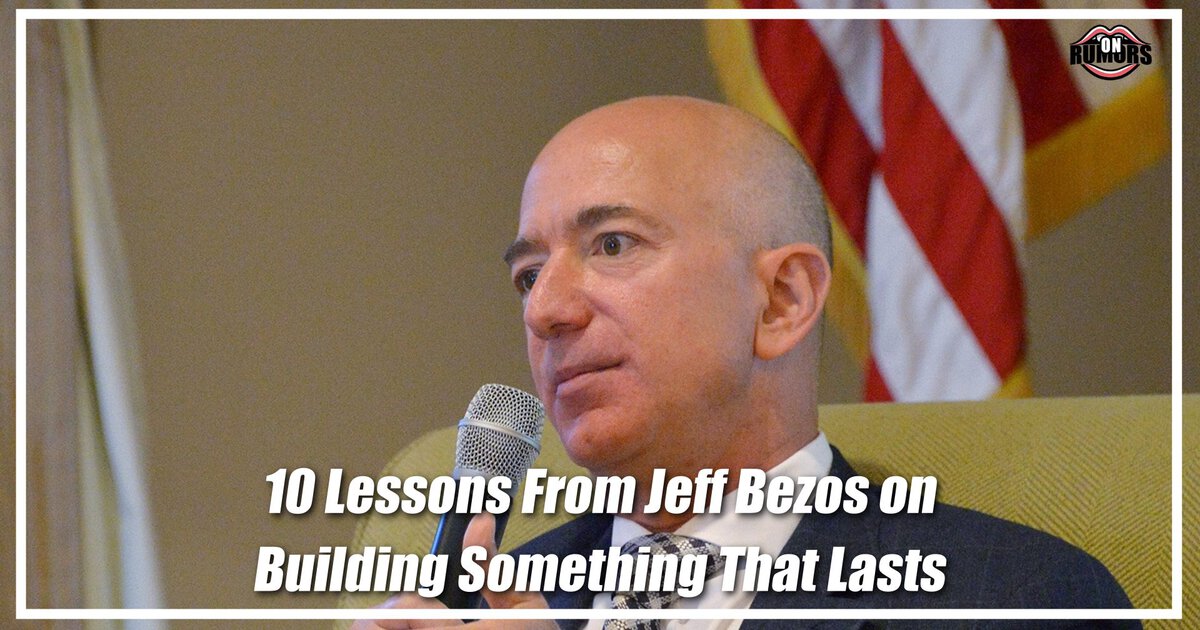
A business that lasts has to do more than attract attention. It has to become useful, keep its promises and adapt when the original plan stops being enough.
Jeff Bezos has returned to those ideas in his shareholder letters and accounts of Amazon's early years. You don't need to admire every decision Amazon has made to examine what is useful in his thinking.
These ten lessons combine ideas he has described publicly with practical questions for your own work. They are prompts to consider, not a promise that following a founder's habits will reproduce his success.
1. Start with the customer's inconvenience
In his 2016 shareholder letter, Bezos argued that customer satisfaction should not be a reason to stop improving. People may want an easier experience before they can describe the solution.
Look at a task from the customer's side. Where do they wait, get confused or have to contact you twice? Fixing one recurring frustration can matter more than adding another impressive feature.
2. Make the first version manageable
Bezos recalled starting Amazon in a Seattle garage and taking packages to the post office himself. The company began with far less infrastructure than it later needed.
Ask what you can deliver well with the resources you actually have. A modest first version can help you learn what people value before you build a much larger operation around your assumptions.
3. Consider the cost of never trying
When explaining why he left his job to start Amazon, Bezos described thinking about the regret he might feel if he never tried.
That is a useful question, but it belongs alongside practical ones. What would a small test look like? What support would you need? How much uncertainty can your circumstances reasonably absorb?
You may be able to explore an idea without making the largest possible commitment on day one.

4. Be candid when you ask for trust
In his 2020 congressional statement, Bezos said he had warned his parents that they could lose the money they invested in Amazon.
The broader lesson is honesty about uncertainty. Whether you want someone to back a project, join a team or become a customer, explain what you know and what you haven't proved yet.
Trust is easier to protect when the promise was realistic in the first place.
5. Expect more than one attempt
Bezos said raising Amazon's first $1 million from outside investors took more than fifty meetings.
Rejection can provide information, but it doesn't always provide a final answer. Ask what the response tells you: does the idea need work, are you speaking to the wrong audience, or is the request unclear?
Persistence is most useful when it includes learning. Repeating the same pitch unchanged is only one possible response.
6. Keep practical lessons from the people who raised you
Bezos described his grandfather as resourceful and willing to tackle difficult repairs on the family ranch.
Think about the useful habits you have seen in other people: asking careful questions, fixing what can be fixed or staying patient when something goes wrong.
Those lessons can be more valuable in daily work than a grand statement about ambition. Notice them, then practice them.
7. Stay curious after something starts working
Bezos's Day One idea asks a growing company to retain the energy and curiosity of a younger one.
A familiar process can become so comfortable that nobody asks whether it still helps. Listen when customers or colleagues point out an awkward step, even if the process was your idea.
Experience should make you better at asking questions, not exempt you from asking them.

8. Test ideas instead of expecting certainty
In his 2016 letter, Bezos described the importance of experimentation and timely decisions. Waiting for complete certainty can mean waiting past the point when an experiment would have been useful.
For your own project, distinguish a reversible trial from a decision that is expensive or difficult to undo. Try the small version where you can, decide what you want to learn and review the result honestly.
Not every idea deserves to grow. Finding that out is useful too.
9. Include employees in your definition of success
In his 2020 shareholder letter, Bezos acknowledged that Amazon needed a better vision for employees and committed to improving its approach to employment and safety.
That acknowledgment matters more as a question to keep asking than as proof that a workplace has solved its problems.
Are people able to do the work safely? Do they have the training, time and support the job requires? Listen to their experience and examine what changes after concerns are raised.
10. Look beyond the transaction
The same letter considered value for customers, employees, sellers and shareholders, alongside wider responsibilities.
For a smaller business, the question can be straightforward: who benefits from the way you operate, and who carries the cost?
Useful products, fair dealings and reliable relationships all belong in the picture. A donation or a successful launch does not replace the everyday work of treating people well.
Put one lesson to work
Choose one problem close enough to change: an unclear promise, a frustrating ordering step or a colleague who needs better support.
Make a specific improvement and see what happens. Building something durable is easier to understand when you bring it back to the next piece of work.